REVIEW · SICILY
Underground Catania
Book on Viator →Operated by Etna 'Ngeniousa · Bookable on Viator
Catania hides a second city underground. I love how this tour turns stone and shadows into a clear story of Roman baths and city-changing events, with expert archaeology guidance. I also love the underground access—places you can’t realistically spot on your own. One thing to consider: it’s sold as private/personalized, but the group is still capped at 8 people.
This is a 2 to 3 hour walking tour in central Catania that mixes major landmarks with real “down below” spaces. Expect four stops, mostly with tickets included, and plenty of time spent looking closely at how Catania was built, rebuilt, and re-shaped by nature.
Since you’ll be moving through underground rooms and caves, plan for a bit of uneven surfaces and low-light conditions. I’d bring sturdy shoes and a light layer for the cool factor that usually comes with underground spaces.
In This Review
- Key highlights you’ll notice right away
- Entering Catania’s Underworld From Piazza del Duomo
- Stop 1: Terme Achilliane Under the Cathedral Area
- Stop 2: Basilica Cattedrale di Sant’Agata and the City’s Faith
- Stop 3: A Putia dell’Ostello and the Amenano Underground River
- Stop 4: Chiesa di San Gaetano alle Grotte and the Lava-Rock Crypt
- What $96.79 Buys: Value, Guide Quality, and Small-Group Access
- Timing, Walking Style, and What to Expect During the 2–3 Hours
- Who This Tour Fits Best (and Who Might Want Something Else)
- Should You Book Underground Catania?
- FAQ
- What language is the tour offered in?
- How long is the Underground Catania tour?
- What sites does the tour include?
- Are admission tickets included?
- How big is the group?
- Where do I meet the tour?
- Is free cancellation available?
Key highlights you’ll notice right away
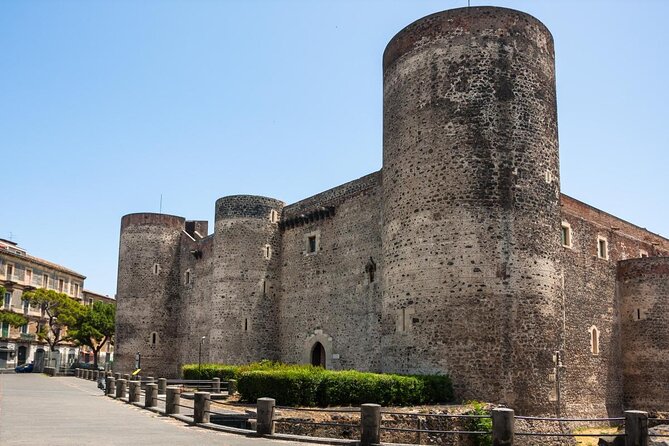
- Small group size (max 8) for a more conversational tour pace
- English-speaking archaeology guide with strong local context
- Terme Achilliane under the Duomo area, tied to 3rd–4th century Catania
- Amenano underground river at A Putia dell’Ostello, including a sliding cave segment
- San Gaetano alle Grotte: lava-flow caves used across Greek, Roman, and early Christian eras
- Mostly included admissions, so you’re not constantly stopping to buy tickets
Entering Catania’s Underworld From Piazza del Duomo
The tour starts at Piazza del Duomo, 7. That’s a smart choice, because Catania’s “surface” and “under” history are tightly connected. You’re not just learning facts—you’re walking through the city the way archaeologists think about it: layers, reuse, and the way eruptions and earthquakes force people to adapt.
You’ll finish in the Piazza Stesicoro area. In practice, that means the tour drops you near a lively part of town for an easy post-tour meal or gelato without having to retrace your steps.
This experience runs in English, uses a mobile ticket, and is capped at 8 travelers. That small cap shows up in the feel of the tour: more time for questions and more chance for the guide to adjust the rhythm. And if you’re trying to avoid a full day outdoors, this is a nice way to see Catania’s story while spending part of your time underground.
You can also read our reviews of more tours and experiences in Sicily.



Stop 1: Terme Achilliane Under the Cathedral Area
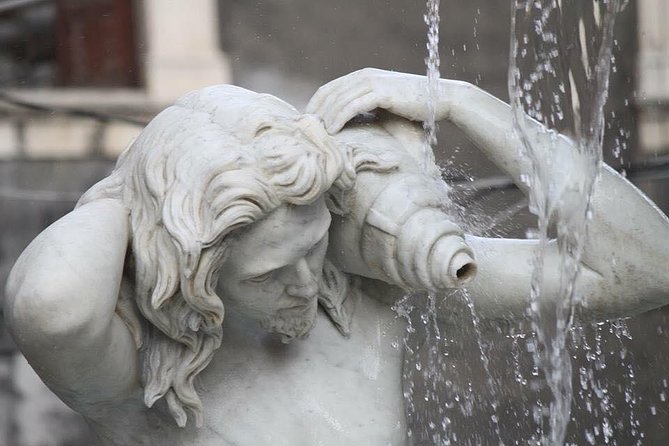
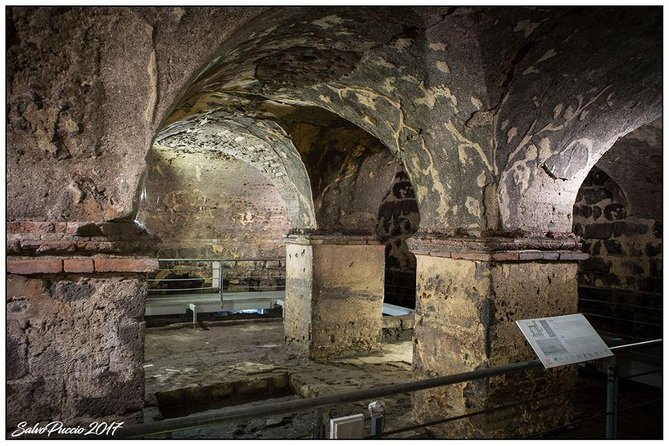
Your first underground stop is Terme Achilliane, a sprawling thermal complex dating to the 3rd–4th century AD. The key detail here is that the site once extended toward Piazza Duomo, but what’s accessible today is the portion that sits just below the cathedral.
That “below the cathedral” framing matters. It’s not a random cave. It’s a reminder that Roman-era public life once sat in the heart of what became modern Catania. The word “sauna” often comes up when people talk about Roman baths, but what I like about this stop is that it’s not just about heat—it’s about how civic spaces worked. Baths were social centers, not just hygiene.
You’ll spend about 20 minutes here, and the admission ticket is included. Practical note: underground rooms can feel more enclosed than you expect. Go in ready to look slowly—this is one of those spots where the important stuff is in the details, not in a single big view.
A potential drawback: if you’re the type who wants lots of sweeping outdoor photography, this stop can feel more about close observation than dramatic scenery. It’s still worth it, because it sets up the theme for the entire tour: Catania built upward—while keeping the past underfoot.
Stop 2: Basilica Cattedrale di Sant’Agata and the City’s Faith
Next comes Basilica Cattedrale di Sant’Agata. This is the heart of Catania in every sense: sacred and everyday life intertwined. The cathedral’s story runs through Norman-era roots all the way to the current Baroque look, with centuries of destruction and reconstruction.
The guide’s job here isn’t just to point at architecture. It’s to explain why the cathedral matters in the bigger Catania timeline, including the city’s long relationship with Liotru and Sant’Agata. Even in a short 20-minute stop, you get a sense that Catania’s big landmarks were shaped by the same forces that shaped the underground spaces—human rebuilding after major shocks.
Admission is free for this stop, so you’re not paying extra to see the main visual “surface” anchor that connects the underground route back to the city above.
If you prefer tours that move quickly between highlights, this one delivers. If you prefer deep museum-style time, 20 minutes can feel short. But in this itinerary, it’s intentionally short: it keeps you moving so the underground stops don’t feel disconnected from the landmark that sits on top of them.
Stop 3: A Putia dell’Ostello and the Amenano Underground River
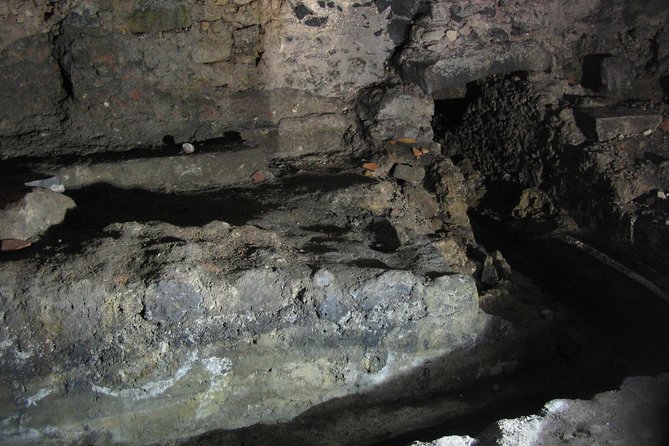
Stop three is where Catania starts to feel like science fiction—in a good way. You’ll visit A Putia dell’Ostello, tied to the Amenano, a mysterious underground river that winds under the historic center.
Here’s the fascinating part: the Amenano originally flowed to the surface and fed the Lake of Nicito. Then, over centuries—because of eruptions, earthquakes, and wars—Catania’s urban layout and natural appearance changed. In other words, water maps didn’t stay put. They were redirected, altered, and partially hidden.
You’ll visit a sliding cave where a branch of the river still flows. I’d mentally file this as both practical and dramatic: it’s water in motion inside a space shaped by geology and human adaptation. This is also the stop that many people remember as the real “wow” moment, since it turns the idea of underground history into something you can almost feel as an ongoing presence.
This stop runs about 10 minutes, and the admission ticket is included. Ten minutes is quick, so if you’re the type who tends to go slow, don’t worry—just set yourself up to absorb what you can, not everything. It’s not a long linger stop by design.
One consideration: because you’re near water and inside a cave-like environment, keep your attention on footing and the guide’s instructions. Even if the tour feels casual, these spaces are still real physical environments, not staged attractions.
Stop 4: Chiesa di San Gaetano alle Grotte and the Lava-Rock Crypt
Your final stop is Chiesa di San Gaetano alle Grotte, and it’s a standout because it’s layered history, literally carved into the ground.
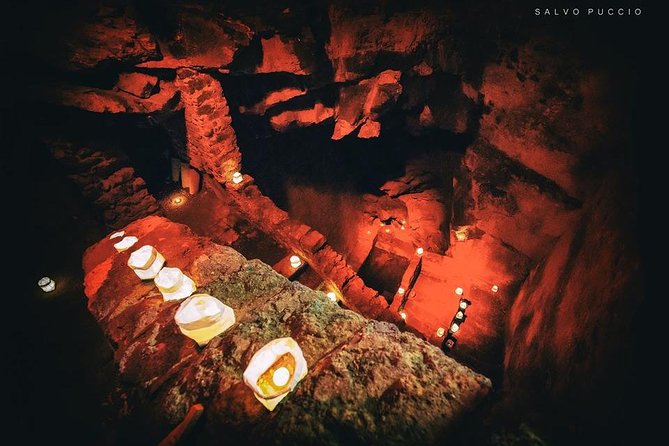
This church sits in a lava-flow cave. According to the tour info, the space was reused in Greek times as a cistern and later as catacomb tomb space by the Romans. Then, a tradition says it was the site of the first deposition of Saint Agatha, and a small church existed as early as 262.
That timeline is the point. You’re not just visiting a religious site. You’re walking into a rock structure that kept getting repurposed across different cultures and eras, all while responding to what the landscape would allow.
Today, the crypt preserves ancient frescoes and decorations carved directly into the living rock. That’s a rare thing: you’re seeing art and symbolism that aren’t painted over a wall—they’re shaped into it. It makes the space feel older than the concept of “tourist photo spot.”
Plan for about 20 minutes here, and admission is included. The vibe can be quiet and a little intense, in a good way. If you like your history with tangible physical evidence, this is where you’ll likely feel it most.





What $96.79 Buys: Value, Guide Quality, and Small-Group Access
Let’s talk money, because underground tours can look pricey on paper. At $96.79 per person, you’re paying for three things that are hard to replicate on your own:
1) Special access. These stops are not the kind of places you stumble into casually. The itinerary focuses on areas that are hard to find or hard to reach without a guiding hand.
2) Interpretation. A good archaeology guide doesn’t just list dates. They connect Roman-era use, later church history, and the way nature events reshape city life. You’ll likely leave with a cleaner mental map of why the underground exists where it does.
3) A human-scale group. With a maximum of 8, you’re not stuck listening to your guide from the back of a bus. The experience is set up so questions can actually happen—and the tour can keep moving without feeling rushed.
I also like that most admissions are included across stops (with the cathedral stop free). That helps you avoid the “add-on surprise” feeling that sometimes happens in multi-stop city tours.
One value caution: if you’re expecting true one-on-one exclusivity every time, keep the group cap in mind. It’s personalized in spirit and tone, but it’s still a small group.
Timing, Walking Style, and What to Expect During the 2–3 Hours
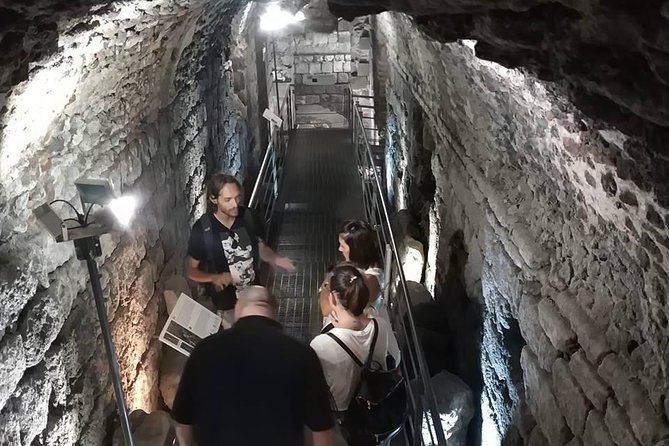
The tour clocks in at 2 to 3 hours. That range usually means you’ll spend most of your time at the underground sites and landmark transitions, with enough pacing to keep it interesting rather than exhausting.
The walking is part of the experience, but it’s not a 10-mile hike. Your biggest “work” is being present—looking, listening, and moving slowly enough to actually notice details in stone and carved surfaces.
For practical comfort:
- Wear sturdy shoes you trust on uneven stone.
- Bring a light layer; underground can feel cooler.
- If you’re sensitive to low light, know you’ll spend real time indoors/cavern-like spaces.
The good news is that multiple reviews highlight guide flexibility—people appreciated when pacing worked for their group needs. So if you need a moment to stare at a frescoed patch or ask one more question, this tour seems designed to accommodate that better than many rushed city walks.
Who This Tour Fits Best (and Who Might Want Something Else)
This tour is a strong match if you:
- want a history-focused Catania introduction that explains how the past shaped the present
- love volcanic and earthquake context as a driver of urban change
- prefer “real places with a story” over a checklist of famous photo spots
- want a break from heat while still sightseeing
It’s also a smart pick for people who don’t have the energy or time for a volcano day. You’ll still get that Etna-and-nature story, just from below the city.
Consider a different option if you:
- want lots of long outdoor scenic viewpoints
- dislike indoor cave spaces or dark crypt environments
- need a very fast-moving tour with minimal time in enclosed rooms
Should You Book Underground Catania?
If you’re choosing between a standard walking tour and something more unusual, I’d pick Underground Catania. You’re paying to see the city from a perspective most visitors never get: under the Duomo, into Roman thermal-era spaces, and into lava-rock religious and burial sites.
The standout strength is the combo of special access + expert storytelling + small group size. Even at $96.79, it feels like your money goes toward making the experience possible—not just toward a generic tour script.
If you like history that’s grounded in physical places, this is a great “first real day in Catania” activity. And if you’re coming back later, the underground viewpoint makes the surface sights mean more.
FAQ
What language is the tour offered in?
The tour is offered in English.
How long is the Underground Catania tour?
It lasts about 2 to 3 hours.
What sites does the tour include?
You’ll visit Terme Achilliane, Basilica Cattedrale di Sant’Agata, A Putia dell’Ostello (Amenano underground river), and Chiesa di San Gaetano alle Grotte.
Are admission tickets included?
Tickets are included for Terme Achilliane, A Putia dell’Ostello, and Chiesa di San Gaetano alle Grotte. The cathedral stop (Basilica Cattedrale di Sant’Agata) has free admission.
How big is the group?
The tour has a maximum of 8 travelers.
Where do I meet the tour?
The meeting point is Piazza del Duomo, 7, 95131 Catania CT, Italy, and the tour ends in the Piazza Stesicoro area.
Is free cancellation available?
Yes. You can cancel for a full refund up to 24 hours before the experience’s start time.