REVIEW · SANTORINI
Santorini: Akrotiri Prehistoric City Guided Walking Tour
Book on GetYourGuide →Operated by NST Santorini Tours · Bookable on GetYourGuide
Pumice preserved a whole town. This Santorini Akrotiri Prehistoric City guided walking tour brings the Bronze Age setting to life with a licensed archaeologist and a close look at pumice-preserved streets and buildings. One thing to keep in mind: this experience can be logistics-sensitive, since a few departures have had guide-matching or timing problems.
I love that Akrotiri isn’t just ruins in a brochure. You’ll connect the town to the Atlantis story people still repeat, while also seeing what the 16th-century BC eruption actually did to a living place. The private-group feel can make it easier to ask questions, but the exact group size at the site can depend on how the day runs.
Plan around the basics. You meet at the entrance of the excavation site (after the ticket office), and your guide can help you get the entry ticket you need (the ticket itself isn’t included). The tour runs about 1.5 hours in English, French, Spanish, or German, with time afterward to keep exploring at your own pace.
In This Review
- Key highlights worth your time
- Akrotiri streets under pumice: why this site feels different
- What your licensed archaeologist actually helps you see
- The eruption story: 16th century BC to 1967 excavations
- After the guide: self-paced wandering and a beach swim option
- Price and logistics for a $424 private-group tour
- Who this tour fits best (and when DIY might be smarter)
- Should you book the Santorini Akrotiri guided walking tour?
- FAQ
- Is the entry ticket included in the tour price?
- Where do I meet my guide?
- How long is the guided tour?
- What languages are available?
- Is this a private group tour?
- Can I cancel for a refund?
Key highlights worth your time
- Licensed archaeologist-led visit to a major Minoan Bronze Age settlement
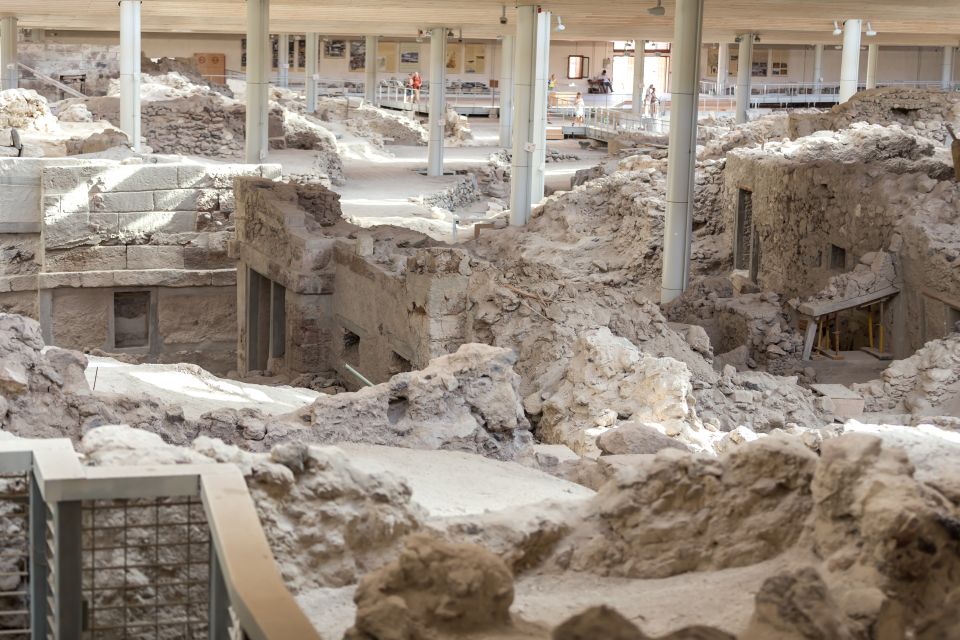
- Pumice-covered city layout: streets, squares, passageways, and workshops
- Two- and three-story houses with clues to wall paintings
- Real context for the 16th-century BC eruption, including the 1967 excavations led by Professor Spyros Marintos
- Free time after the tour to wander and check out the nearby beach for a swim
Akrotiri streets under pumice: why this site feels different
Akrotiri is one of those rare archaeology stops where you don’t just see objects—you see a whole town plan. The eruption in the 16th century BC wiped out daily life, and then pumice covered everything thickly enough to keep much of it intact for roughly 3,500 years. That preservation is the reason the place is so compelling: you can walk through an ancient city layout instead of staring at scattered fragments.
During your guided portion, you’re shown how the town worked. Expect to hear about the city’s houses, streets, squares, and workshops, not just temples or big monuments. One of the best parts of an Akrotiri visit is the way it helps you picture ordinary routines—living spaces, movement through the town, and where people likely made or stored goods.
This is also where the Atlantis connection enters the picture. The myth is often tied to large-scale disasters and vanished civilizations, and Akrotiri gives people a tangible starting point for those stories. Even if you’re not hunting mythology, the eruption theme makes the site’s layout feel more dramatic. You’re looking at a city that stopped suddenly, then reappeared centuries later through excavation.
A practical note: entry tickets are separate from the tour cost. Your guide meets you at the excavation entrance after the ticket office, and you can get help buying the entry ticket before you start.
You can also read our reviews of more tours and experiences in Santorini.



What your licensed archaeologist actually helps you see
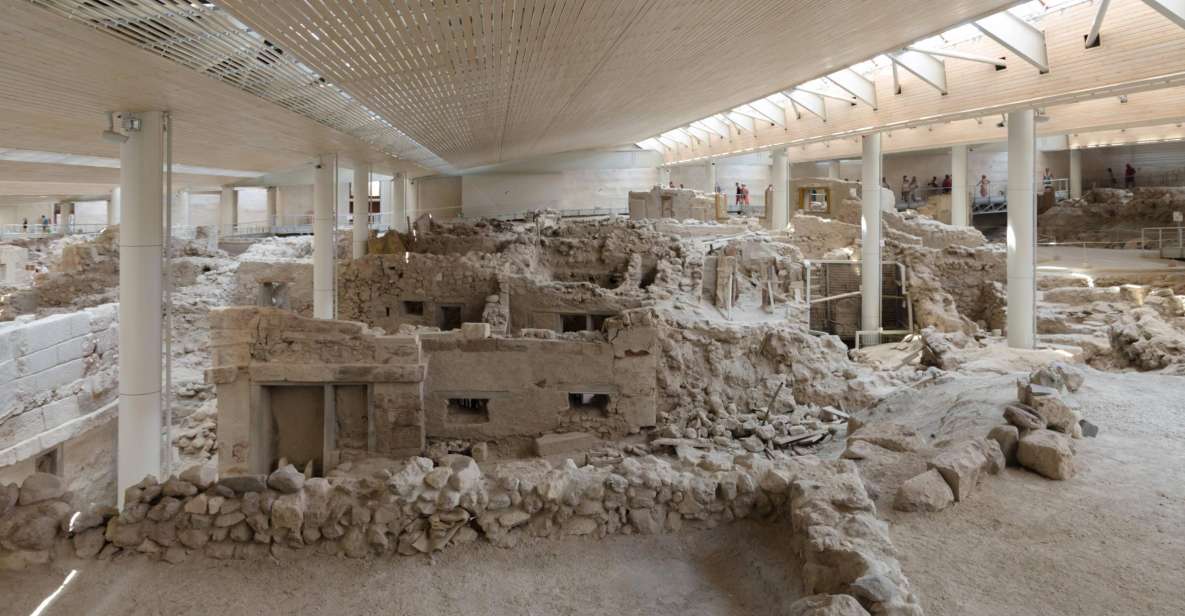
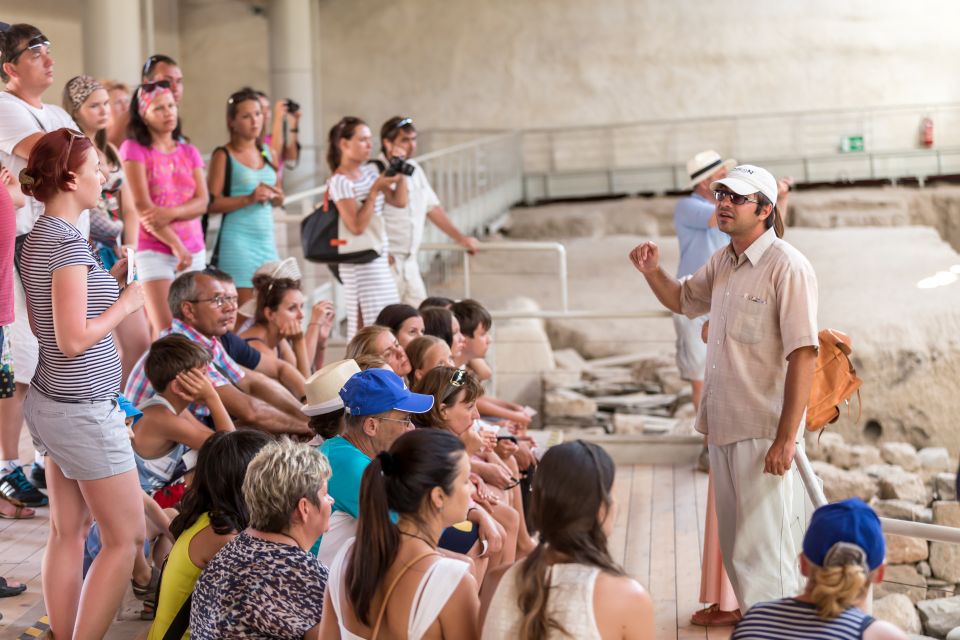
The heart of this tour is the guided walking portion with a licensed archaeologist. With a good guide, Akrotiri turns from a site you’re looking at into a site you’re understanding. You’ll walk through the excavated area and get an explanation of what you’re seeing and why it matters.
Here’s what the guide focus is built around:
- the volcanic eruption that destroyed life on the island and how much was preserved under pumice
- the city plan, including roads, squares, and built passageways
- the architecture, including two- and three-story houses
- the art and daily-life evidence, like the pottery and signs that some rooms were decorated with wall paintings
The value of a licensed archaeologist is that you’re not left guessing. You’re walking through partially exposed structures, so interpretation matters. Even when the remains are well preserved, there’s a lot that would be hard to connect without someone guiding you through the logic of the site.
Also, your group is framed as a private group. That should mean less crowd noise and more chance to ask questions. Still, pay attention to how the tour runs that day, because group matching can affect how much you get to hear and how individualized your experience feels.
Tour duration is about 1.5 hours, so this isn’t a multi-hour seminar. It’s long enough to get oriented and pick up the main themes—eruption, preservation, and how a Bronze Age town functioned—then short enough to let you explore on your own afterward.
The eruption story: 16th century BC to 1967 excavations
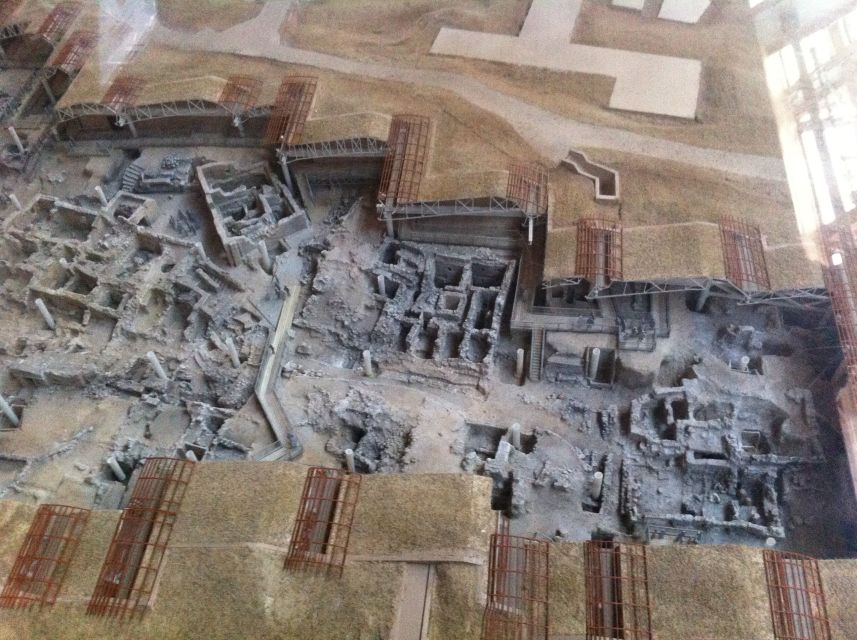
Akrotiri’s storyline is the same one people keep coming back for: a civilization gets swallowed by a natural disaster, and then the evidence waits. The eruption destroyed life on Santorini and left much of the city collapsed beneath the waves. The site stayed undiscovered until excavations began in 1967, led by Professor Spyros Marintos.
What I like about having this context from a guide is that it changes how you read the buildings. Instead of seeing random walls and floors, you start looking for evidence of sudden change and preservation conditions. The tour explains how a thick blanket of pumice covered the city and helped preserve structures for nearly four millennia. That’s the reason certain areas look so legible—like you’re walking through a town blueprint.
This is also why Akrotiri is often linked with the bigger story of Minoan-era Greece. The tour positions Akrotiri as one of the most important Minoan Bronze Age settlements of Greece. Even if you already know the broad timeline, hearing it tied directly to what you can stand in front of makes the history feel less abstract.
If you’re a history fan, you’ll probably leave with the sense that Akrotiri is both tragedy and time capsule. If you’re not, you’ll still get something useful: the feeling that the site is arranged in a way people actually lived in, not just a set of monuments.
After the guide: self-paced wandering and a beach swim option
One of the smartest parts of this tour design is the free time to continue exploring after the guided walk. After the main explanation, you can move through the site at your own pace and look longer at the areas that catch your attention.
This is where you can take your new knowledge and test it in real time. You’ll know what to watch for: how the town sections relate to each other, where roads and passageways run, and how the overall layout connects houses, squares, and workshops. When you have time to linger, you also have time to notice details like the pottery and architectural elements that a fast group tour might skip.
The experience also includes a practical add-on: after the site, you can visit the nearby beach for a swim. That’s a nice pairing. You get a concentrated dose of archaeology, then you switch gears to the modern island rhythm.
Price and logistics for a $424 private-group tour
Let’s talk money and the one thing that can make or break your day: how smoothly you meet your guide.
The price is $424 per group up to 2, and the tour lasts about 1.5 hours. The entry ticket is not included, so you should expect to pay that separately. The tour cost is really paying for three things:
1) a licensed archaeologist guide
2) a guided route through a complex site (so you’re not just reading walls)
3) a private-group experience plus time to keep exploring afterward
Because the price is per group up to two, the value is usually best if you’re splitting it with a partner or friend. If you’re traveling solo, it can still be worth it if expert guidance matters to you, but you should weigh it against visiting on your own and spending the extra money on something else in Santorini.
Now the logistics part. The overall rating is 3.1 from 36 reviews, and several entries point to problems like:
- overbooking or mismatched group size
- confusion finding the assigned guide at the meeting point
- guides arriving late or not arriving
- private bookings getting merged with larger tours, making it harder to hear
I can’t promise you those issues won’t happen, but you can plan in a way that reduces the risk. Here’s the practical approach I’d use: arrive early enough that you’re not rushing your ticket purchase, and be ready to adapt if your group gets combined. Since the meeting point is specific—entrance of the excavation site after the ticket office—you’ll want to treat that like a precise target, not a vague suggestion.
Also, if you book hotel transfer, pickup details are sent by email after booking, so check spam folders.






Who this tour fits best (and when DIY might be smarter)
This guided walk is a strong fit if you want a guided interpretation without spending the whole day at a museum. You’ll get the core story—pumice preservation, the 16th-century BC eruption, and Akrotiri’s city life evidence—in the time it takes to do the main site circuit.
It also fits well if your group wants structure. Akrotiri is easier to understand when someone connects streets, squares, houses, and workshops into a believable town plan. The licensed archaeologist role matters most here, since the site rewards attention to detail.
That said, this is not the best choice if you strongly depend on flawless timing. Since there have been reports of guides not showing, being late, or joining groups at the last minute, you should only book it if you can handle a little uncertainty. If your schedule is tight, or you’re the type who hates scrambling at the start, consider visiting independently and using printed or on-site information.
If you do book, I’d aim for the mindset of getting a guided explanation plus the freedom afterward. The free time and the nearby swim option are real perks. You’ll still get your independent exploration, even if the guided portion runs with a little less individualized pacing than you expected.
Should you book the Santorini Akrotiri guided walking tour?
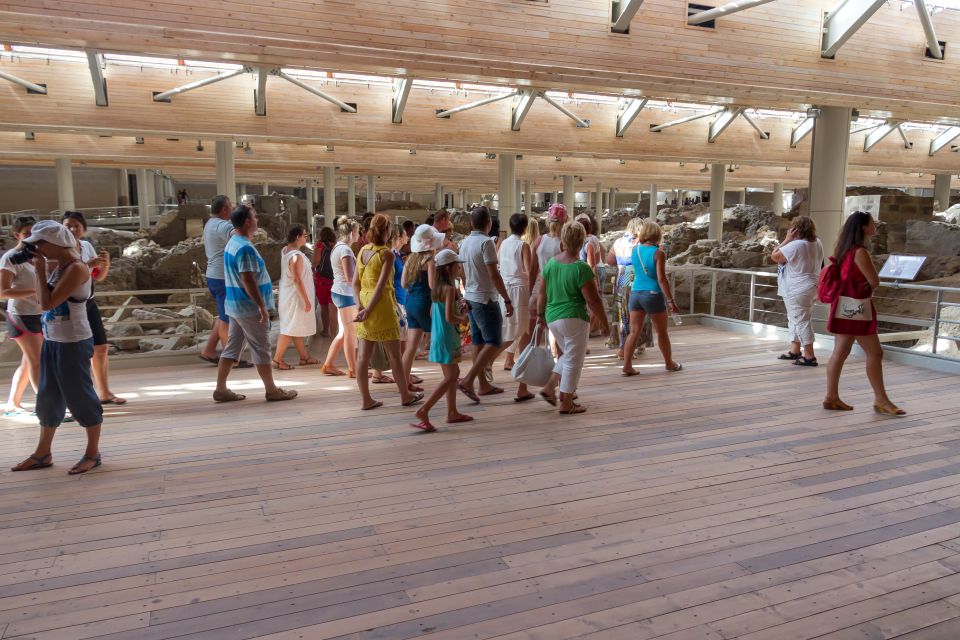
I’d book this tour if:
- you want a licensed archaeologist explaining what you’re seeing
- you’re excited by Bronze Age town life—streets, squares, pottery, and houses
- you like the idea of a short guided session, then self-paced wandering
I’d think twice if:
- your priority is a perfectly private, perfectly on-time guide experience
- you have limited flexibility at the site and can’t absorb meeting hiccups
- you’re fine with learning at your own pace without a guide
My bottom line: Akrotiri itself is worth your time. The tour can be an efficient, meaningful way to understand what you’re looking at, but it’s smart to treat meeting and guide reliability as part of the decision. If you value expert guidance, you’re likely to feel happy with the payoff—just show up early and stay ready.
FAQ
Is the entry ticket included in the tour price?
No. The tour price includes a licensed archaeologist guide and free time afterward, but the archaeological site entry ticket is not included. Your guide can help you at the ticket office before you start.
Where do I meet my guide?
Meet your assigned guide at the entrance of the Akrotiri excavation site, after the ticket office.
How long is the guided tour?
The tour duration is about 1.5 hours.
What languages are available?
The live tour guide is available in English, French, Spanish, and German.
Is this a private group tour?
Yes. It’s a private group experience.
Can I cancel for a refund?
Yes. Free cancellation is available if you cancel up to 24 hours in advance for a full refund.