REVIEW · GRAN CANARIA
Half-Day Adventure and Climbing Via Ferrata in Gran Canaria
Book on Viator →Operated by MOJO PICON AVENTURA · Bookable on Viator
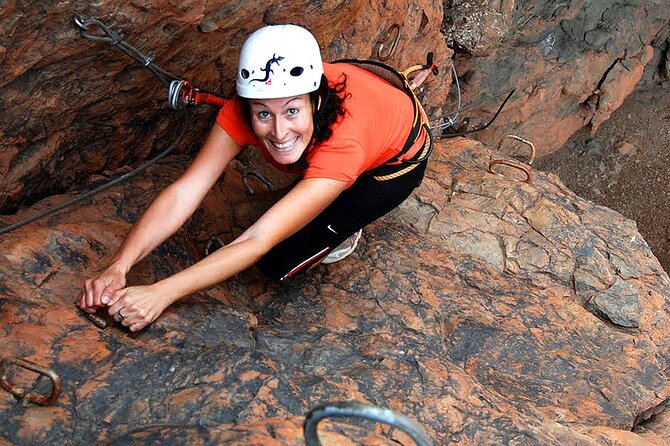
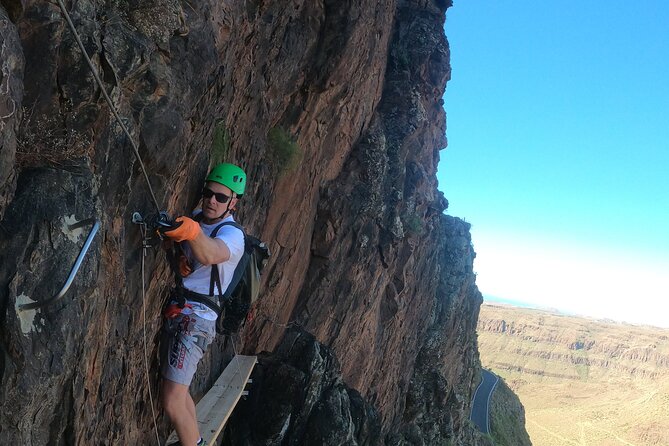
Gran Canaria has a way of surprising you, and this via ferrata is one of the better surprises. It’s a half-day vertical hiking adventure built around metal rungs, chains, and bridges, taking you up a 70m wall along a 300m route with a steel cable keeping you secured.
What I like most is how intentionally it’s set up for first-timers who want structure, not chaos. You get a real guide-led start, and the whole thing is designed to feel safe and doable—especially with guides like Victor and Miguel noted for being patient and reassuring.
One thing to consider: this is not for people with significant vertigo. You’ll be moving high on a secured route, and the activity is still physically demanding even if you’re hooked in.
In This Review
- Key things to know before you go
- H2: Meeting at Mirador Astronómico de la Degollada de las Yeguas
- H2: How the Gran Canaria via ferrata really works (70m up, 300m along)
- H2: Safety that’s built into the experience, not added after
- H2: What happens during the roughly 4-hour half day
- H2: The “vertical hiking” trick: challenging, but structured
- H2: Guide quality is the difference between nervous and confident
- H2: Price and value: $81.68 for 4 hours that actually adds up
- H2: Who this via ferrata suits best (and who should think twice)
- H2: Weather, timing, and the kind of day you’re signing up for
- H2: Should you book this Gran Canaria via ferrata?
- FAQ
- Where is the meeting point for the half-day via ferrata?
- What time does the activity start?
- Is pickup available?
- What should I know about safety and equipment?
- How fit do I need to be?
- What is the cancellation policy if the weather is bad?
Key things to know before you go
- 70m wall, 300m route: a proper “vertical” workout, not a short stunt section
- Steel cable secured the whole time: helmet, harness, and anchor lines are used throughout
- Small groups (max 8): enough attention without feeling crowded
- First-time friendly mindset: guides focus on pacing and confidence, including for nervous climbers
- About 2 hours of climbing: the route time gives you a real experience, not a quick sample
- Pickup available in the south: you can meet at 9:30 without needing a car
H2: Meeting at Mirador Astronómico de la Degollada de las Yeguas
The day starts at the parking lot of the Mirador Astronómico de la Degollada de las Yeguas (San Bartolomé de Tirajana). The meeting time is 9:30am, and the activity ends back at the same spot, so you’re not trying to solve transport at the end of a high-energy climb.
If you don’t have a vehicle, you may be able to get pickup around 9:00am as long as you’re staying in the south of the island. That matters because a via ferrata works best when you arrive calm and ready, not stressed about finding the meeting point with gear in hand.
I like that the meeting location is tied to a known landmark with a straightforward navigation link. It’s an easy way to get your bearings fast before you start dealing with harnesses and heights.
You can also read our reviews of more tours and experiences in Gran Canaria.

H2: How the Gran Canaria via ferrata really works (70m up, 300m along)
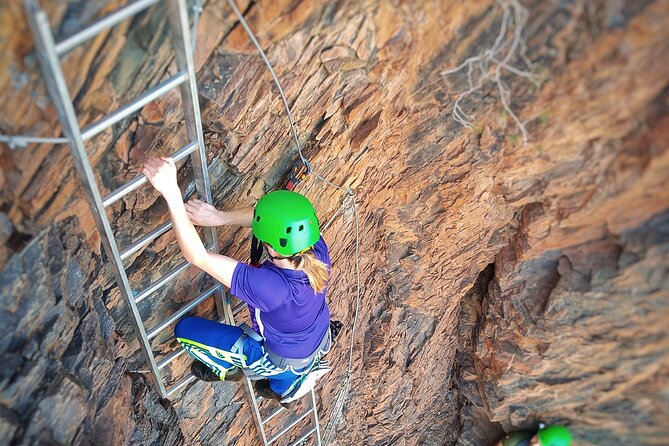
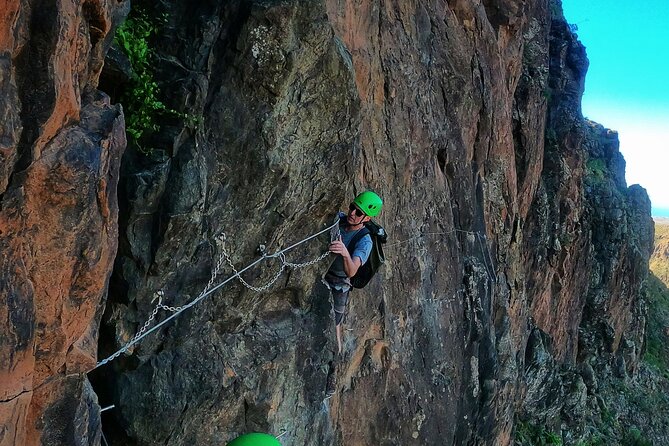
A via ferrata is basically a walking route designed for climbing. Instead of loose rock and pure scrambling, you move through a system of metal elements—staples, steps, chains, stairs, and bridges—so you can focus on technique and balance.
Here’s the key detail for your expectations: this route goes up a 70m high wall on a 300m route. In other words, you’re not just testing a few rungs. You’re doing a real climb with a defined start-to-finish line.
You’ll be equipped with a helmet, harnesses, and anchor lines, and you advance while secured by a steel cable at all times. That’s the difference between “I’m afraid of heights” and “I can handle heights.” If you’re nervous, cable security helps you stay in motion without the feeling of being one slip away from disaster.
The big caution is straightforward: it’s essential not to have vertigo. Even with the safety system, your brain has to accept the height and the exposure. If you know you get dizzy on balconies, stairwells, or scenic overlooks, take that seriously before booking.
H2: Safety that’s built into the experience, not added after
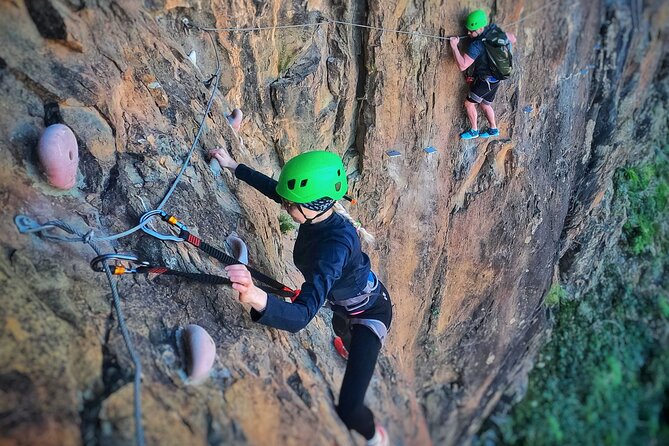
The safety story here isn’t just theory. Guides like Victor and Miguel come up repeatedly, and the most consistent theme is how they keep people at ease and moving at an appropriate pace.
This matters because via ferrata success is partly gear and partly nerves. When you’re hooked in and the guide is explaining what to do next, your job gets simpler: find the next rung, keep three points of contact when possible, and breathe. More than one comment praises how people felt safe and how guides helped during the moments that normally make first-timers hesitate.
Also, the group size is capped at 8 travelers. That usually means you get more attention during the briefing and more chances to ask questions before you start climbing. It’s a good match for riders who learn better by doing rather than by listening for too long.
H2: What happens during the roughly 4-hour half day
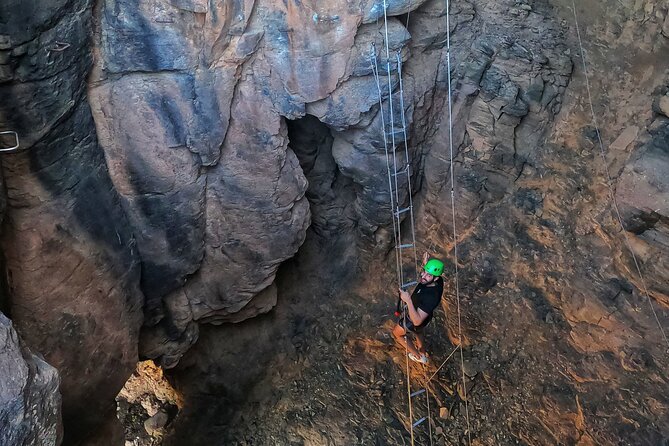
This experience runs about 4 hours total, and that timing is usually split into a clear rhythm: arrive, gear up, climb, then recover and head back.
You’ll start at 9:30am at the parking lot. Expect some kind of introduction and setup before you touch the route—this is when the helmet/harness/anchor lines matter most. You’ll also get guidance on how the cable system works so you know how you’ll be supported while moving along the metal features.
A useful detail: one account notes the climb takes around 2 hours. That helps you judge the effort. You’re not going to be out there all day, but you are going to spend enough time on the wall that your legs, arms, and grip get involved.
Between climbs and pauses, you’ll stay close enough to the guide that you can adjust your pace. The best part of a half-day structure is that you still have energy afterward. You get a serious mountain moment without burning your whole day.
Then you finish back at the meeting point. That closed-loop setup is practical for visitors who don’t want to rebuild their plans after an activity that can run long in rough conditions.
H2: The “vertical hiking” trick: challenging, but structured
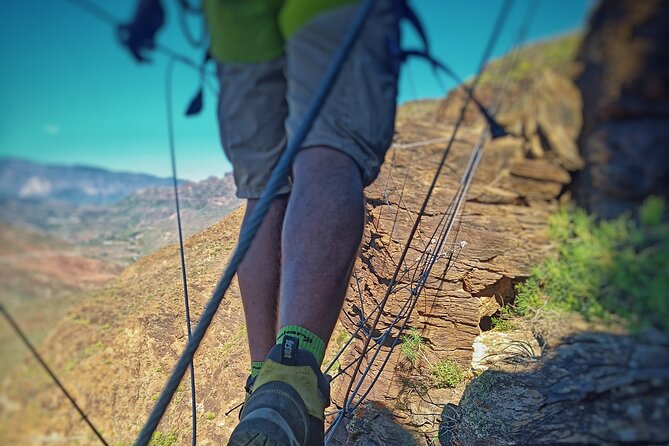
Via ferrata is often described as climbing, but what makes it special for tourists is how it turns vertical terrain into a guided pathway. Instead of guessing where to put your hands, the route tells you. Instead of searching for safe footholds, the metal system gives you repeatable options.
That’s why I think it’s a strong first step into the vertical world of climbing. You still use real climbing skills—balance, grip, and body positioning—but you’re not doing it with the full uncertainty of uncontrolled rock climbing.
It’s also a good test of whether you enjoy exposure and controlled height. Even if you don’t finish every segment, you’ll learn a lot about your comfort level and your stamina.
And yes, the route comes with those “you can’t fake this” moments where you look down and feel the scale. One of the repeated positives is the combination of a climb you can manage and stunning views over the mountain range. That mix—movement plus payoff—keeps the time from dragging.


H2: Guide quality is the difference between nervous and confident
This tour shines most when you’re on the route and things get momentarily tricky. That’s where good guiding matters.
Multiple comments highlight that guides were:
- patient when someone needed support
- informative about how to approach the route
- friendly and easy to work with
- quick to help without taking control away
You can see why this is valuable. On a via ferrata, you’ll hit sections that require calm decision-making: when to move, where to place your feet, how to handle transitions between metal elements. A guide who keeps you focused on the next step (not the whole wall) helps you turn fear into rhythm.
If you’re doing your first via ferrata, prioritize tours where guides manage pacing. If you’re more experienced, you’ll still appreciate the structure because it keeps the route smooth and prevents “false starts” that waste energy.
H2: Price and value: $81.68 for 4 hours that actually adds up
At $81.68 per person, this isn’t a “cheap thrill” activity. But it also isn’t overpriced for what you’re getting—especially when you compare it to independent climbing lessons plus equipment plus a safe route.
What you’re paying for is:
- a guided, secured climb with helmet/harness/anchor lines
- a small group setting
- a full half-day plan that includes pickup options for the south
- access to a route designed with metal features so you’re not improvising
For many people, the real value is the safety net and the coaching. If you’ve ever tried to learn technical activities on your own, you know the cost of mistakes isn’t just money—it’s time, stress, and sometimes injuries. This format reduces guesswork.
Also, with an activity like this, the “per hour” math can be misleading if the climbing portion is short. Here you’re getting enough route time that it feels like a real adventure, with climbing around 2 hours noted by at least one participant.
H2: Who this via ferrata suits best (and who should think twice)
This is for you if:
- you have moderate physical fitness
- you want a safe, guided intro to climbing-style movement
- you’re comfortable using a harness system and following instructions
- you want a half-day plan that leaves room to explore the rest of the island
It’s not a great match if:
- you have strong vertigo or get dizzy at height
- you expect a casual walk with no exertion
- you’re hoping for something that feels fully “hands-off” like a normal hike
One more detail to consider: confirmation happens at booking, and the tour is listed in English. If you’re traveling with someone who needs another language, you’ll want to check directly.
H2: Weather, timing, and the kind of day you’re signing up for
This experience requires good weather. If conditions aren’t right, you’ll either be offered a different date or a full refund. For a via ferrata, that makes sense—traction, visibility, and overall route conditions matter.
You can also plan around the schedule: meeting is 9:30am, and the drive-or-walk to the meeting point is part of the morning rhythm. The calm start is helpful because the climb demands focus.
And since this is a small-group experience (up to 8 travelers) booked on average 14 days in advance, you’ll likely want to reserve once you know your travel dates—especially if you’re coming in a busier season.
H2: Should you book this Gran Canaria via ferrata?
I’d book this if you want a real mountain experience without needing prior climbing experience, and you appreciate the peace of mind that comes from being secured by a steel cable the whole time. The biggest selling point is the blend of structure and supportive guiding—especially highlighted by Victor and Miguel—plus the fact that the climb is long enough to feel like you earned it.
I’d think twice if you know you struggle with heights even when you’re safely secured. In that case, no amount of guide reassurance changes the core reality: you’ll be high on a vertical route.
If your goal is confidence, not bragging rights, and you’re okay with a moderate workout in exchange for big views and a memorable way to “do climbing” safely, this via ferrata is a solid choice in Gran Canaria.
FAQ
Where is the meeting point for the half-day via ferrata?
You meet in the parking lot at Mirador Astronómico de la Degollada de las Yeguas, 35107 San Bartolomé de Tirajana, Las Palmas, Spain.
What time does the activity start?
The start time is 9:30am, and it ends back at the meeting point.
Is pickup available?
Yes. Pickup is offered if you stay in the south of the island, with pickup around 9:00am. You’ll need to contact the provider with your accommodation details.
What should I know about safety and equipment?
You’ll use a helmet, harnesses, and anchor lines, and you’ll be secured by a steel cable at all times. Not having vertigo is essential.
How fit do I need to be?
The tour requires a moderate physical fitness level.
What is the cancellation policy if the weather is bad?
Cancellation is free. You can cancel up to 24 hours in advance for a full refund. The experience requires good weather, and if it’s canceled due to poor weather, you’ll be offered a different date or a full refund.